
 Yahoo Autos
  Motoramic
End of the Ford Econoline marks a new era for great American vans
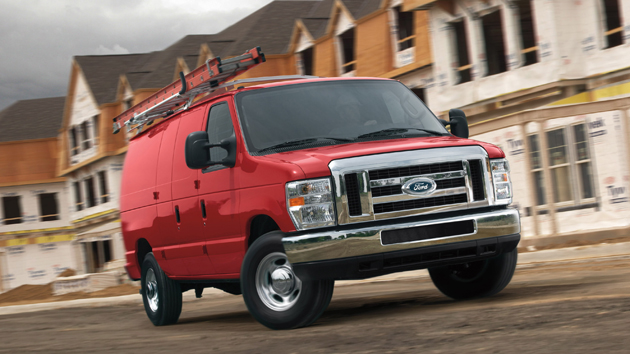
If you ever wanted to really get to know a Ford E-Series van, better hurry. Because after a long — check that, absurdly long — run, it's finally retirement time for America's most famous and most geriatric hauler; take a bow, you body-on-frame, mostly V-8 people mover. It's so old it always looks like it's starring in some '70s Quinn Martin production or an episode of Dragnet.
When the former Econoline receives a gold watch for service at the end of the 2013 model year, Ford will finally begin building for the American market the unibody Transit van they sell in Europe and around the world. It's a big deal, and although many of us can't help holding a sentimental, snuggly soft spot for the Econoline, the cue for this old stager to shuffle off comes not a nanosecond too soon.
Like the upcoming Chrysler Ram vans, based on a couple of Fiat's home-market schleppers, the Doblo and the Ducato, Ford's Transit launch in the U.S. is what counts for meaningful progress along the slow road to a more rational U.S. fleet. Here's why:

What stands out in this look back is a remarkable reluctance to move beyond a formula that works. While European buyers have always been able to look forward to new models every five or six years, the American van buyer has had to wait dozens of years and usually more for the sorts of big improvements only a redesign with the latest thinking and technology can bring. In the same time frame as we've gotten to know, for instance, eleven complete redesigns of the Toyota Corolla, pens have been lifted extensively but two or three times in service of the vans of the formerly Big Three since the '60s.
One central irony: Faced with serious competition abroad, American companies started offering better vans to their customers outside the United States in the '60s and '70s, with great strides made every decade since. But here at home, competition was stayed, as was progress. Van design, like a woolly mammoth in a late 1960s ice floe, was frozen in time as the companies collectively appear to have agreed, with the willing assent of the federal government at its bipartisan best, to call a truce amongst them selves, skip a development cycle or three, and collectively supply their countrymen with less than the best vans known to man.
It was as if we Americans were suddenly third-world citizens, offered an inferior product at a greater profit to the sellers, who were in this ironic instance, our countrymen. Like consumers in less developed lands, the choices in the U.S. market were substandard and limited, because, basically, they could get away with it, just like in less privileged lands.

Remember the vanning craze of the 1970s? Long before families were being directed to profligate, cheap-to-build SUVs by Detroit, they were being invited, in an experimental sort of way, to get into thirsty, cheap-to-build vans as family transport and personal party palaces, the flames of desire stoked by automakers who knew easy money when they saw it. Only later when it emerged that SUV desire was much easier to flame than van lust, did the van start returning more fully to its utilitarian roots, which thankfully for the industry (or not) required it to work and invest even less.
One way Detroit helped itself maintain the status quo in van-dom for so long was to lobby for exemptions from federal passenger car safety and emissions standards for vans, much like early SUVs enjoyed. This allowed superannuated van designs to soldier quite a bit further down the road than they ought to have. And while they were doing so, Ford, GM and Chrysler were making the funny money that comes only rarely in corporate life when you have a product that runs forever, with its capital costs fully amortized, development and production lines fully paid for and a customer base that keeps turning out to buy it.
The appeal is obvious, but to sell an ancient product with a straight face, you need to know you won't have any competition. The customer has to need you, and having virtually no other choice than you, history tells us, helps. It really does.
There may not be enough proof to meet the legal standard for proving the elements of felony collusion — although there might -- but how else do you explain the smart and talented engineers of some of America's biggest industrial corporations managing to go dozens of years without redesigning their vans, in the ways you would have wanted to, for reasons of safety, efficiency, environmental impact and utility?
Where the average American van continues to this day to rely upon the fossilized body-on-frame structure the industry was born building, true to its roots in the wagon and horse-drawn carriage trade, the average European or Japanese offering by the 1980s was lighter, and more space and fuel-efficient. Owing to the use of tall, unit-body construction and smaller, primarily diesel, engines, it was of equal or superior practicality.
My own van conversion experience occurred when we bought a Freightliner Sprinter in 2002. As a manager of touring rock bands, I was intimately familiar with Detroit's offerings and had come to rely exclusively on Econolines, which were about as good as it got, but thirsty, never more so than in the 10-12-mile-per-gallon gasoline-powered V-10 Econolines that came out in the late '90s. Enter the Sprinter a few years later along with its standard five-cylinder diesel that got us 27 mpg while towing — in a duallie Sprinter no less. Compared to the Ford, the Sprinter was quicker, had a bigger payload, could tow as much, rode better, had a dramatically smaller turning circle and you could stand up in its load area. What was not to like? This is what we vannists were missing in America.
Unfortunately, the Sprinter, which replaced the bargain basement Dodge van in the DaimlerChrysler era, was and is on the expensive side; still worth it to many, but allowing Ford and GM to contentedly carry on peddling their traditional fare, embarrassed though they ought to have been, selling many hundreds of thousands of vans each year owing to price, habit and misguided brand loyalty.
Not surprisingly, the American industry worked hard to create the conditions for sumptuous decades of technical stasis in the van realm, lobbying for tariffs that served as barriers to foreign competition. Safety and emission exemptions and import duties completed the sweep of the fortuitous pre-condition table as reliably unfavorable exchange rates also worked against imported machinery. Japan's growing automotive powerhouses, making huge bank selling cars in America, and fearing retaliation in the form of sales quotas, didn't dare work the van or full-sized pickup angle.
Oddly enough, when the Japanese firms recently did begin building trucks here, they chose to compete by selling heavyweight body-on-frame trucks, going head-to-head with the most recherché American designs rather than doing something new and clever. Particularly egregious: the Nissan NV van. Introduced in 2011, it was a not-so-bold step back into the 1960s, with the frame of Nissan's old school Titan pickup residing underneath its portly van body, its ancestry belied by a long and cumbersome prow, and fuel economy charitably described as dismal.

Overall, we know better now, or so one likes to think, and we're delighted to report a new generation of trucks that are lighter, more pleasant and dramatically more abstemious draws near.
To the list of the clever things Fiat chairman Sergio Marchionne has done for Chrysler, add getting the jump on the competition in getting America the trucks it deserves. The sad, secret fact that in many fundamental (if not all) respects almost all European vans have long since become better than American ones is now officially out of the bag. Fiat's opportunity was clear and they've taken it, good for them.
So welcome the upcoming Doblo, Ducato and Iveco Daily vans, three sizes, small to large, all Fiat products likely to be renamed Ram-something. Chrysler has had nothing in the van segment it once bulked up on, since its break up with Daimler-Benz, which took the Sprinter along with Chrysler's solvency a few years back. Happily, the Fiat product doesn't just fill a hole for a re-imagined Chrysler, it's promises, like its new Dodge Dart, to be rather decent.
So too the new Ford Transit. Lighter and leaner that what came before it, it should be quicker than the Econoline it replaces yet it will be considerably more economical and vastly more nimble. In addition to its standard powerplant -- Ford's regarded and now-proven Ecoboost V6 -- a four-cylinder turbo-diesel is a possibility on the horizon. The Transit will complement the smaller Transit Connect. Introduced to the rest of the world in 2002 but the U.S. only recently, the small, front-drive world van built in Turkey is a handsome little carrier that if nothing else proves that even if Ford's thinking in the van arena isn't much at home, it's still quite sophisticated elsewhere.
Next to the Econoline's current 20 year run or the jaw dropping 32-years afforded Chevrolet's 1964-1996 van, the current Chevrolet Express Van and its GMC Savannah twins are mere striplings of 16. But they could get a lot older. With the onslaught of new Ford and Chrysler-Fiat product imminent, it has fallen to GM to take the low road and stick with the tired hardware they finished paying for years ago, and it's taken up the challenge, at least temporarily until some still unspecified day when it may unify around a single global van platform, the Opel Movano. Though Opel doesn't get credit for being a key center of GM excellence, its engineering staffs' involvement is essential to its successful re-entry into the world van market on level footing. There is very good reason to fear an all American effort at a new van would at this late date miss the mark.
Because Detroit has fallen behind the rest of the world's vans. It has, in van terms, played survival of the fittest and lost. Yet, ironically, its fitter competitors were often subsidiaries of itself, their own organization only on the other side of the ocean. Over decades the companies' bifurcated product lines provided a valid test of the Big Three's view of the world — one set of rules for America, one for the rest of the globe. Consonant with their ideas of passenger cars, they developed two completely different types of vans in parallel on several continents and, in the end, one of the lines proved superior. That it was the European one on both occasions probably surprises us Americans more than anyone else. In the end, virtues like economy and reduced weight must always triumph.
So farewll Econoline. We knew ye all too well.
